

Malta has over 420,000 active social media users, but the best audience for a Meta campaign isn’t simply the biggest one. Effective Meta ads campaign setup in Malta starts with people who match your offer and service area, then uses a 1-3% lookalike audience when you have a customer list or high-value website visitors. If your business can serve customers beyond Malta, consider whether an EU audience fits your offer instead of restricting reach locally.
Choosing an audience is only one part of Meta ads campaign setup in Malta. The campaign objective should match the action you want people to take, whether that is discovering your business, engaging with content, submitting an enquiry or making a purchase. This guide covers how to choose audiences and objectives, set a workable budget, track conversions and test creative. It also explains why focused setup and regular adjustments matter in Malta.
Key Takeaways
- Match audience targeting to your offer: focus locally, account for seasonal visitors, and consider wider EU reach when your business can serve those customers.
- Set a budget that gives the campaign enough conversion data to learn, then avoid spreading limited spend across too many campaigns.
- Test distinct creative formats and opening hooks, and refresh ads when response starts to weaken.
- Choose the campaign objective that matches the action you want, from awareness and engagement to leads or sales.
- Set up conversion tracking and review results against qualified enquiries, bookings or purchases before making changes.
What is the best Meta Ads audience for Malta businesses?
For Meta ads campaign setup in Malta, define your audience by customer, location and intended action. Start with people your business can serve, then test whether broader targeting brings more qualified results.
Local, Tourist, and International Audiences
Malta has a population of 550,000 and over 420,000 active social media users. For local services, target locations you serve and distinguish between customer types. Tourism businesses can separate visitors from residents, with May-October identified as peak season. Malta receives 2.9 million tourists annually, so visitor-focused messages can address short stays and booking needs. If your business serves customers across borders, consider EU targeting rather than limiting reach to Malta.
Facebook and Instagram Audience Targeting
Over 90% of Maltese internet users have a Facebook or Instagram account, so assess both platforms against your audience and objective. Choose placements based on the creative and intended action, then compare outcomes across Facebook, Instagram, Messenger and Audience Network. Use qualified enquiries, bookings or sales to judge their contribution, not reach alone.
Audience exhaustion matters in Malta’s compact market. A funded campaign can cycle through its reachable audience in weeks, raising frequency as responses fall and costs rise. Monitor frequency alongside enquiries, bookings or sales. If the same people see an ad repeatedly and results weaken, refresh the creative or broaden relevant targeting. For lookalikes based on customer lists or high-value website visitors, test 1-3% similarity.
Keep targeting, objective and creative aligned. A restaurant seeking reservations needs a different message from a retailer seeking online purchases. Test one audience hypothesis at a time and compare qualified actions, not just traffic. Use English-language creative for most campaigns in Malta, and consider Maltese copy when it suits the audience and offer. If response declines, refresh the creative rather than assuming a previous winner will keep working.
Meta’s advertising policies apply to both ads and their destinations, and requirements can vary by product or sector. Review Meta Advertising Standards before launch, especially for restricted areas such as health and finance. The ad, targeting and destination must all comply with the relevant policies.
Common setup risks include narrowing a small audience with too many filters, choosing traffic when the goal is leads, and judging success by clicks alone. Another mistake is leaving the same creative live after response falls. Before publishing, review the objective, location, audience, placements and destination in Ads Manager. Then measure results against your business goal.
For example, a hotel can target people currently in Malta with booking-focused creative during May-October, while testing resident offers separately. This makes audience and message performance easier to interpret. Tie each test to a clear outcome, such as a completed booking, rather than combining visitors, residents and international prospects in one result. A well-structured Meta ads campaign setup for Malta businesses keeps audience tests focused and measurable.
How much should a Malta business spend on Facebook Ads?
Set your advertising budget according to the conversions you need and can measure. For businesses in Malta, budget size, customer acquisition costs and campaign structure all affect how quickly Meta can optimise.
Customer Acquisition Costs and Lead Costs
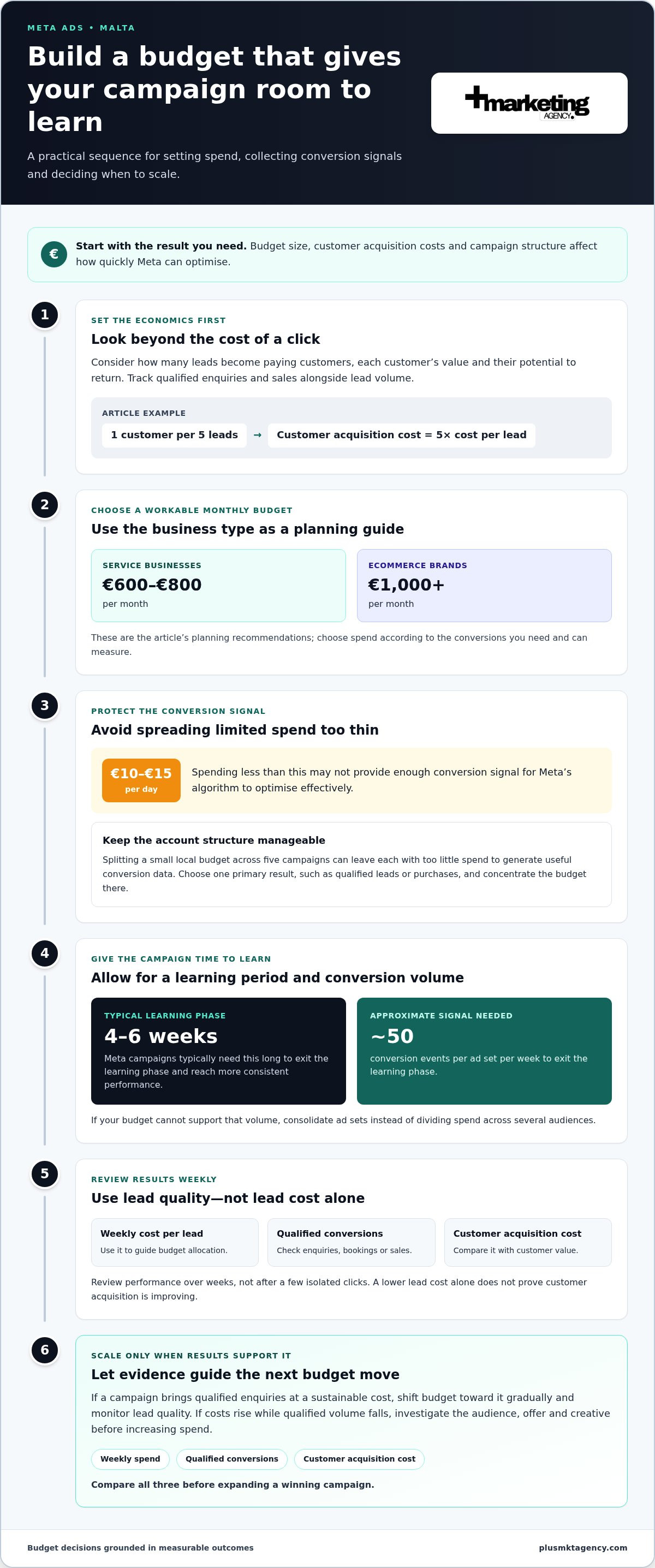
Start with a customer’s value, not just the cost of a click. Lead costs are not customer acquisition costs: factor in how many leads become paying customers, each customer’s value and their potential to return.
For example, if a service business converts one in every five leads into a customer, the cost to acquire a customer will be five times the cost per lead. Track qualified enquiries and sales alongside lead volume. This gives you a more useful basis for deciding whether advertising supports profitable growth.
Recommended Budgets and the Learning Phase
Service businesses can plan around €600-€800 per month, while ecommerce brands are advised to allocate €1,000 or more monthly. Spending less than €10-€15 per day may not provide enough conversion signal for Meta’s algorithm to optimise effectively.
Meta campaigns typically need 4-6 weeks to exit the learning phase and reach more consistent performance. Meta needs roughly 50 conversion events per ad set per week to exit that phase. If your budget cannot support that volume, consolidate ad sets rather than dividing spend across several audiences.
Keep the account structure manageable. Splitting a small local budget across five campaigns can leave each campaign with too little spend to generate useful conversion data. Choose one primary result, such as qualified leads or purchases, and give that campaign enough budget to collect signals. Review performance over weeks, not after a few isolated clicks.
Use weekly cost per lead to guide budget allocation. If a campaign attracts qualified enquiries at a sustainable cost, shift budget toward it gradually and monitor lead quality. If costs rise while qualified volume falls, investigate the audience, offer and creative before increasing spend. A lower lead cost alone does not prove that customer acquisition is improving.
Scaling should follow evidence, not interest in a larger reach. Compare weekly spend, qualified conversions and customer acquisition costs before expanding a winning campaign. For a Malta business, conversion tracking helps connect campaign activity with measurable outcomes. That makes budget decisions more consistent and clarifies whether to optimise the current setup or test a different allocation.
Creative formats, hooks, testing, and refresh cadence
Creative affects whether people in Malta notice, understand and act on an ad. Match each format and message to its placement, then assess results against the campaign objective.
Facebook and Instagram Creative Formats
For Facebook and Instagram Stories and Reels, test vertical video in a 9:16 ratio, lasting 15-30 seconds. Aim to communicate the offer within the first three seconds, before viewers scroll past. For Facebook feed placements targeting older Maltese demographics, consider 60-90-second videos that explain the offer clearly. A B2B company can test a 30-second video showing a specific business problem and its solution.
Let the format support the message, not dictate it. A restaurant can show a dish and make the booking action clear, while a service business can use a concise demonstration. Use English-language creative for most campaigns in Malta, and consider Maltese copy when it suits the audience and context.
Creative Strategy and Testing
Build a testing plan around distinct hypotheses: one opening hook, one offer angle or one format. Keep the audience and objective consistent during each comparison, so results help explain which creative difference mattered. In 2025, campaigns with different creative could generate results that differed by 300-500%. That makes structured testing more useful than relying on personal preference.
Compare outcomes tied to the goal, such as qualified enquiries, bookings or purchases, rather than views alone. Meta creative performance can shift between a campaign’s first and fourth week, so review results regularly and prepare new variations. A monthly creative review can help you plan replacements before response weakens.
Make copy specific. State who the offer is for, what problem it addresses and what action to take. For example, a Maltese hotel could pair a room image with a direct booking message, while a B2B firm could lead with a recognisable operational challenge. Keep the headline, visual and destination aligned, so the click leads to the promise made in the ad.
Test creative elements in a controlled sequence. Start with two different hooks and the same core offer, then compare qualified actions. Next, try a different visual or video format with the stronger message. This helps separate the effect of the hook from the effect of the format, without changing every campaign element at once.
Creative quality accounts for 70-80% of Meta Ads performance, making production and refresh planning operational priorities. Review frequency, response and conversion quality together; if results weaken, refresh the message or format rather than simply increasing spend. AI-powered creative campaigns can support the development of varied concepts, while human review keeps each ad relevant to Malta’s audience and business offer.
Campaign objectives for awareness, traffic, engagement, leads and sales
Choose the objective that reflects the business result you want Meta to optimise for. Structure the campaign around the customer’s next action, not simply the message or format you plan to publish.
Awareness and Traffic Campaigns
Awareness suits a Malta business introducing a new offer, service or brand to people who may not know it yet. Measure delivery and meaningful attention, rather than treating impressions as sales. Traffic suits a campaign designed to bring people to a website or other destination. Check whether those visits lead to useful actions, such as viewing a service page or checking availability.
For example, a new hospitality business could use awareness to build recognition, then traffic to bring interested people to its booking information. Meta and Google Ads can serve different roles: Meta can introduce an offer during social browsing, while search advertising can reach people actively looking for a solution.
Sales Campaign Objectives
Choose a sales objective when the intended action is a purchase and your website can record that event. An ecommerce shop should optimise for completed purchases, not just product-page visits. Compare order volume and revenue with your business goal, then assess whether the campaign attracts valuable customers.
For bookings or enquiries, select the objective that matches how customers complete the action. A completed booking is different from a click to the booking page. Define the conversion clearly before launch so Meta receives a signal tied to the result that matters.
Engagement is useful when the intended response is interaction with a post, video or page. It can help a business in Malta assess whether a message earns comments, saves or video attention. However, engagement alone does not show whether people will become leads or customers. Keep the measure aligned with the campaign’s purpose.
For lead generation, decide whether prospects should submit details through an instant form or your website. A training provider, for example, might value completed course enquiries over link clicks. Assess lead quality as well as volume, including whether enquiries match the service and whether your team can follow up effectively.
Use this decision sequence before building the campaign:
- Awareness: Introduce a business, service or offer to relevant people.
- Traffic: Bring people to a destination and assess what they do there.
- Engagement: Encourage a defined interaction with content.
- Leads: Collect enquiries that can be qualified and followed up.
- Sales: Optimise toward purchases or another recorded transaction.
Give each campaign one primary outcome. If a retailer wants both video views and purchases, separate those goals and evaluate each against its own measure. This makes results easier to interpret and helps identify whether the message, audience or conversion path needs adjustment.
How do I set up a Meta Ads campaign step by step?
Build the campaign in sequence: define the result, prepare tracking, configure the audience, then launch and review. For a Malta business, each step should connect the ad setup to an actual enquiry, booking or purchase.
- Set the business goal. Choose one main outcome, such as qualified leads, bookings or online sales. Agree on a starting budget and the action that will count as a conversion. A Malta hotel, for example, might measure completed bookings rather than clicks to its rooms page.
- Check the account and offer. Use an active Meta Business account and ad account. Confirm the promoted offer, audience and destination are ready before creating ads. A campaign needs a clear next step, such as a booking form or product page, to give interested people somewhere relevant to act.
- Prepare the conversion path. Make sure the landing page explains the same offer as the ad and works on mobile. Set up conversion measurement for the action you selected. Where tags are used, manage cookie consent before tags fire, so tracking setup accounts for consent choices.
- Review the audience and restrictions. Select the locations and customer groups that match your service area. Review sector-specific advertising restrictions, including those for health and finance, before launch. Keep the audience relevant to the offer instead of adding filters that make Malta’s reachable market unnecessarily narrow.
- Build the campaign structure. Select the objective that matches your goal, then set the audience, placements, budget and schedule. Keep the number of campaigns manageable, especially when working with a small local audience. Use an ad set structure that gives each test a clear purpose and enough budget to gather useful signals.
- Prepare and check the creative. Match each ad’s copy, visual and call to action to the landing page. Preview placements across Facebook and Instagram, including mobile formats. Check spelling, destination links and the conversion action before publishing, then confirm the ad reflects the offer accurately.
- Launch and optimise. Review delivery and conversion data after launch, then make changes based on results rather than isolated clicks. Campaigns can typically go live within 5 to 10 working days after creative and landing pages are approved. Initial signals about channel performance can arrive within 2 to 4 weeks.
A consistent process makes each adjustment easier to evaluate. Plan your Meta campaign setup around the goal, tracking and launch steps that fit your Malta business.
Plus Marketing Agency: Meta Advertising
Plus Marketing Agency helps businesses in Malta plan and manage Meta Advertising around clear commercial goals. Turn to the team when campaign objectives, audience targeting, creative testing or conversion measurement need a more structured approach. Campaign activity can be connected to qualified enquiries, bookings or sales, giving you a clearer basis for optimisation.
If you are weighing Meta against search demand, Google Search Visibility can complement social campaigns. Lead Generation and Conversion Tracking also support a setup focused on capturing and measuring customer actions. The right next step depends on your offer, target audience and campaign needs.
Contact Plus Marketing Agency to discuss your Meta advertising goals.
Turn Your Campaign Plan Into a Growth System
Make your next step operational: decide who owns campaign decisions, how results will inform changes, and how advertising connects to your sales process. Meta ads campaign setup in Malta works best as part of a commercial system, not as a standalone launch. Your team should know what counts as a valuable customer action and how to respond when it happens.
Plus Marketing Agency can connect Meta Advertising with Lead Generation and Google Search Visibility, aligning campaign activity with the outcomes your business needs. The focus is a clear path from audience attention to measurable customer action, followed by performance insights that guide the next decision.
If you’re ready to put that approach into practice, contact Plus Marketing Agency to discuss your advertising goals. Take the next step with a plan built around how your business grows.
Frequently Asked Questions
Do Facebook Ads still work in Malta in 2025?
Yes, Facebook Ads remained a viable option for Malta businesses in 2025. The platform can support local discovery, enquiries and sales when campaigns target relevant customers and measure meaningful actions. Malta has over 420,000 active social media users, and the average Maltese user spends over 45 minutes per day on Meta platforms. Treat those figures as potential reach, not a guarantee that every viewer will become a customer.
How do I target tourists in Malta with Facebook Ads?
Build a separate campaign for visitors currently in Malta, and match its message to what they can do during their stay. A hotel could promote available rooms, while an attraction could highlight booking information and practical visit details. May-October is the peak season for tourism businesses advertising to people in Malta. Align campaign timing and creative with the offer’s availability and booking journey.
How long does it take to see the first result?
Early campaign signals can arrive within 2 to 4 weeks, while enquiries and sales can begin within the first two weeks after launch. These refer to different indicators: an initial click or enquiry is not the same as consistent, qualified results. Track the event that matters to your business, such as a completed booking, and assess whether the resulting customers fit your offer.
What Meta Ads campaign objectives are available and which should I choose?
For the goals covered here, choose awareness, traffic, engagement, leads or sales. Select awareness to introduce an offer, traffic to encourage visits, and engagement to prompt interaction. Choose leads when people should enquire, and sales when you want to optimise for purchases. For example, a service business seeking consultations should measure qualified enquiries, not page views. Give each campaign one primary business outcome.
How do I set up Meta Business Suite, Ads Manager, and a Meta Pixel?
Use Meta Business Suite to organise your business’s Facebook and Instagram presence, then use Ads Manager to build and manage campaigns. For website conversion measurement, configure a Meta Pixel and define the actions to track, such as a submitted enquiry or completed purchase. Test that events register correctly. Manage cookie consent before any tracking tag fires, and connect measurement to the action your campaign is optimising for.
What audience targeting options work best for businesses in Malta?
Start with location and customer relevance, then test broad targeting against audiences based on existing customer information. A business with a customer list or high-value website visitors can test a 1-3% lookalike audience. Compare results by qualified enquiries or sales, not audience size alone. If your offer can serve customers outside Malta, assess whether EU targeting makes commercial sense instead of limiting reach to the island.
What daily budget and ad costs should I expect for Meta Ads in Malta?
For Meta ad spend, the guidance is €10-€15 per day as a level below which conversion signals may be limited. Service businesses are advised to budget €600-€800 monthly, while ecommerce brands are advised to allocate €1,000 or more.
How do I target Malta by location, language, and audience?
Set Malta as the location if you serve customers nationally, then narrow targeting only where your service area requires it. Use English-language creative for most campaigns and consider Maltese copy when it fits your audience and context. Base audience criteria on customer needs and the offer rather than piling on filters. If you can serve customers across borders, assess EU reach as a separate targeting decision.
