

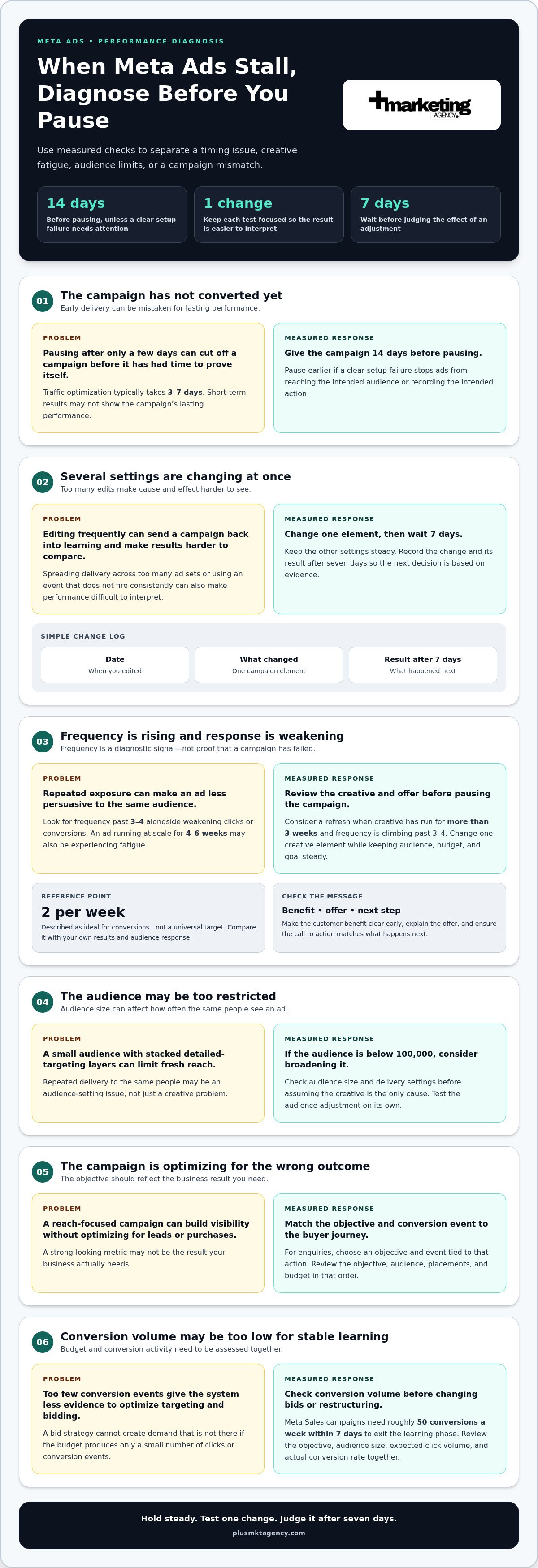
A campaign that hasn’t converted yet isn’t automatically a failed campaign. Give it 14 days to prove its worth before pausing, and check that its performance goal matches the result you want. If Meta ads aren’t converting, the right goal may matter as much as the time you allow the campaign to run.
It’s frustrating to spend budget without generating leads or sales, especially when your Meta ads are getting attention. But pausing too early, changing several settings at once, or optimising for the wrong event can make it harder to find what’s holding performance back.
This guide explains when to wait, when to pause, and how to work out whether the issue is creative fatigue, budget, tracking, the landing page, or the campaign goal. You’ll learn to change one thing at a time and give the result seven days before judging it. Start by diagnosing the conversion path, then make a measured adjustment instead of reacting to a short-term dip.
Key Takeaways
- Give a campaign 14 days to prove its worth before pausing, unless a clear issue needs immediate attention.
- Review creative when it has run for more than three weeks or frequency climbs past 3-4, then refresh rather than making several changes at once.
- Change one campaign element at a time and wait seven days before judging its effect.
- Check whether the budget and conversion volume can support the learning phase before changing bids or restructuring campaigns.
- For purchase-focused campaigns, choose a performance goal that maximizes conversions or their value and use purchase as the conversion event.
1. Ad fatigue, frequency, and creative refreshes
Repeated exposure can make a once-effective ad less persuasive to the same audience. Frequency shows the average number of times each person saw an ad. Treat a frequency past 3-4 as a prompt to check creative fatigue, not as automatic proof that the campaign has failed. Compare frequency with results: if impressions continue but clicks or conversions weaken, investigate the creative and offer.
Timing provides another useful signal. Refresh the creative when it has run for more than three weeks and frequency is climbing past 3-4. An ad running at scale for 4 to 6 weeks may also be experiencing fatigue. These are diagnostic cues, not fixed pause rules; judge them alongside audience size, delivery and conversion activity.
Review the message before replacing the whole campaign. Does the opening line or first frame state the customer benefit? Is the offer clear, and does the call to action match the next step? For example, an ad promoting a booking should show why the booking is worthwhile, rather than opening with a broad brand message. A new visual cannot fix an offer that gives people no reason to act.
Make one creative change at a time. Keep the audience, budget, and conversion goal steady while testing a different opening, format, or proof point. This helps you see whether the new creative changed the response, rather than mixing together several possible causes. If the ad attracts interest but people drop out later in the funnel, refreshing the creative alone may not solve the problem.
Frequency also depends on audience size. If an audience is below 100,000 people and detailed targeting layers are stacked, consider broadening the audience. Narrow targeting can repeatedly serve the same people, limiting room for fresh reach. Check delivery and audience settings before assuming the creative is the only cause.
A frequency of 2 per week is described as ideal for conversions, but it is a reference point, not a universal target. Compare the figure with your own results and audience response. If frequency rises past 3-4 while performance weakens, prepare a relevant creative refresh. If the offer, message and audience still fit, adjust the ad rather than pausing the entire campaign. When Meta ads aren't converting, that distinction helps separate creative fatigue from a deeper funnel or offer problem.
2. How long should I wait before pausing a Facebook ad campaign?
Give a campaign 14 days to prove its worth before pausing it. Traffic optimization typically takes 3-7 days, so judging results sooner can mistake early delivery for lasting performance. Pause earlier if a clear setup failure prevents ads from reaching the intended audience or recording the intended action.
Audit the objective, audience, placements, and budget in that order. Check that the objective matches the business result you need, the audience fits the offer, placements can deliver, and the budget supports the goal. This quick review can uncover a mismatch before you blame Facebook ads or switch them off.
Frequent edits make it harder to understand cause and effect. Editing too often, spreading delivery across too many ad sets, or choosing an event that doesn’t fire consistently can return a campaign to the learning phase. The campaign then has to adapt again, making results harder to compare with the previous setup.
Change one campaign element at a time, then wait seven days before judging the result. For example, if leads have slowed, adjust the audience first while keeping the creative, budget, and objective steady. This controlled test shows whether changing the audience helped, instead of leaving several possible causes unresolved.
Match the objective to the buyer journey, not just the metric that looks strongest today. A reach-focused objective can build visibility, but it isn’t the same as optimising for leads or purchases. If you need enquiries, choose an objective and conversion event tied to that action. Otherwise, the campaign may optimise for the wrong outcome.
A falling return on ad spend (ROAS) calls for investigation, not an automatic pause. Compare the decline with lead quality, conversion volume, and any changes to the offer or sales process. A short dip after a campaign edit may reflect renewed learning; a sustained decline alongside weak business results points to a deeper issue. Fatigue in one ad doesn’t mean every campaign has failed.
Keep a simple change log with the date, what you edited, and the result after seven days. This record can show which adjustments preceded a ROAS decline and whether the same issue returns. It also helps prevent repeated edits based on memory or a single poor day.
If repeated changes make performance difficult to interpret, a structured campaign review can help clarify the next test. Keep the campaign stable long enough to learn from that test, then pause only when the evidence points to a persistent mismatch.
3. Bidding, budget and learning-phase conversion volume
A campaign needs enough conversion activity for Meta’s algorithm to learn which people are most likely to act. Meta Sales campaigns need roughly 50 conversions a week within 7 days to exit the learning phase. If your campaign records fewer, delivery can remain less stable, and each conversion gives the system less evidence for optimizing targeting and bidding.
Budget determines how many opportunities a campaign can enter in the auction. If your budget produces only a small number of clicks or conversion events, a bid strategy can’t create demand that isn’t there. Before changing bids, review the objective, audience size, expected click volume, and actual conversion rate together.
A sudden cost increase can also reflect market conditions, not just campaign settings. If CPMs rise by 30% across an industry, that may indicate an auction-wide shift rather than a problem with one campaign. Compare delivery and costs across your own campaigns before treating a higher CPM as proof that your strategy has failed.
Scaling requires controlled changes. Increasing a campaign budget by 200% in the same week as other changes can force it to relearn. Avoid combining a major budget increase with new targeting, creative, or bidding settings. Change one factor, then assess whether conversion volume and cost move in the intended direction.
Meta’s ad policies can restrict approval or delivery, and targeting options may be limited for certain campaign categories or audiences. Check the account’s delivery status, rejected-ad notices, audience settings, and location targeting to identify restrictions that may be limiting reach.
To diagnose Meta Pixel and Conversions API tracking, test the journey from ad click through completed conversion, then confirm that each event fires once and at the expected time. iOS 14.5 privacy changes can disrupt Meta Pixel tracking, so compare Events Manager activity with completed actions in your own records.
For benchmarks, outbound-link click-through rates can generally range from 1 to 5%. CPC, CPM, and conversion-rate expectations depend on the objective, audience, offer, and conversion quality, so compare like-for-like campaigns rather than treating one figure as universal.
In Malta, compare costs and conversion results across campaigns with the same objective, audience type, placement mix, and measurement setup. Review your own trends across comparable periods, since different offers and conversion paths can produce different costs.
Use the learning phase as a diagnostic, not a reason to change everything at once. Check delivery, conversion events, and budget capacity first. Then adjust the constraint that is limiting useful data.
4. Why are my Facebook ads getting clicks but no conversions?
Clicks show that an ad attracted attention; they don’t prove the landing page did its job. Open the exact destination linked in the ad, then compare its headline, offer, and call to action with the ad’s promise. If an ad promotes a specific service but sends visitors to a general homepage, that disconnect can break the conversion path.
Page speed is a practical first check. Aim for a landing page that loads in three seconds or less, and test it on both a mobile connection and desktop. A slow page delays the offer and gives visitors a reason to leave before they see the form, product details, or booking option.
Mobile usability matters because over 90% of Meta traffic is mobile. Open the page on a phone and complete the conversion yourself: tap the main button, enter the required details, and submit the form. Check whether text is readable, buttons work, fields are manageable, and no error blocks the next step.
Form friction can turn qualified clicks into abandoned visits. Review each field and remove requests that aren’t needed for the next business step. For example, a simple enquiry form shouldn’t demand details that sales staff can collect later. Then test the full journey again, from ad click to successful submission.
Trust signals should support the decision near the point of action. If reviews sit near the footer, 60% of mobile visitors may never scroll down to see them. Move relevant reviews, clear contact details, and useful product or service information closer to the offer and call to action, where they can address a visitor’s concern.
Conversion rate gives context to clicks. One example of a potential product-page improvement for premium brands is a rise from 1.8% to 3.5%; treat this as an illustration, not a target for every business. Compare results on the same page and traffic source after a specific change, such as clearer pricing information or a more visible purchase button.
A landing page is at least half the problem in eight out of ten cases when a Meta campaign isn’t converting. Treat that as a reason to inspect the page, not to assume the ad is blameless. Check whether the offer is compelling, the destination matches the ad, and the page works properly on mobile.
Finally, test the conversion event. Follow the journey from click to completion and verify that the event fires at the expected point. Accurate conversion tracking helps distinguish a genuine lack of action from a page or measurement problem, so decisions reflect completed outcomes rather than clicks alone.
5. Choosing the correct performance goal
A campaign can attract traffic and still optimise for the wrong result. In Ads Manager, start with the business outcome you need: awareness, visits, leads, or purchases. Then choose a performance goal that directs delivery towards that outcome. If you need sales, traffic alone doesn’t tell Meta to prioritise people likely to buy.
For purchase-focused Meta campaigns, set the performance goal to maximise the number or value of conversions and choose purchase as the conversion event. Select conversion value when differences in order revenue matter to your strategy. Choose conversion volume when your priority is securing more purchases, regardless of their individual value.
Before launch, trace the path from the ad to the actual action. A purchase campaign needs a relevant destination and a functioning purchase event. If the event is missing, delayed, or triggered by the wrong action, Ads Manager can’t reliably report the outcome you want to optimise for.
Match each objective to its role in the funnel. For example, a traffic campaign can send visitors to a product page, while a purchase campaign focuses delivery on conversions. Don’t judge the first campaign by purchases if its selected goal is website visits. Assess it against its intended result, then use a sales-focused setup to pursue purchases.
Check the selected goal and event in Ads Manager before changing the creative or audience. Confirm that the event matches the action named in the ad, then test the journey from click to completion. If the ad promises a booking but the event records only a page view, the reported result won’t reflect actual bookings.
Volume also affects what a campaign can learn. If purchases are scarce, the system receives fewer optimisation signals, and results may be less stable. Check whether the chosen event occurs consistently and whether the campaign objective reflects the strongest meaningful action available. A lead campaign may suit an enquiry-focused funnel better than an unmeasured purchase event.
Separate delivery metrics from business outcomes. Clicks and landing-page views show activity, while purchases and their value show commercial results. Compare the metric that matches the selected goal, then inspect the conversion path if the campaign is meeting its goal but sales are still missing.
For a final check, write down the desired outcome, selected objective, performance goal, and conversion event. Each should describe the same customer action. If those settings don’t align, correct the mismatch before pausing an otherwise active campaign. Get help aligning campaign goals with conversions when you need a structured review.
Plus Marketing Agency: Meta Advertising
Plus Marketing Agency helps businesses improve campaign performance through Meta Advertising, Lead Generation, and Conversion Tracking. Turn to the team when you’ve reviewed the objective, creative, audience, and landing page but still can’t identify where enquiries or sales are being lost.
Conversion Tracking connects campaign activity with the actions that matter to your business. Lead Generation focuses campaigns on attracting potential customers, while Meta Advertising supports campaign planning and optimisation around your goals. Google Search Visibility can also help businesses reach people through search.
The next step is a focused conversation about your campaign goal, current tracking, and the point where prospects stop progressing. Contact Plus Marketing Agency to discuss your Meta advertising needs.
Make your next campaign decision with confidence
If your Meta ads are not converting, use the next decision to build a clearer operating process. Record the business outcome you want, the signal you’ll use to assess progress, and the change you plan to test. This gives you a useful reference for future campaigns and helps your team make evidence-based decisions instead of reacting out of frustration.
For businesses in Malta, Plus Marketing Agency connects paid activity with commercial goals through Meta Advertising and Lead Generation. Google Search Visibility can also support customer acquisition when search intent matters to your growth plan. The next step is a focused review of what you need the campaign to deliver and where performance is breaking down.
Bring your campaign goal, current results, and the questions you still need answered. Contact Plus Marketing Agency to discuss a practical path forward. A sharper measurement process can make every future campaign decision more deliberate and useful.
Frequently Asked Questions
How long should I wait before pausing a Facebook ad campaign?
Use 14 days as a practical evaluation window, unless a technical or delivery problem needs immediate action. Before pausing, compare results with your normal sales cycle: a considered purchase may take longer than an instant enquiry. Check whether people who clicked later converted through another channel, too. That context helps distinguish weak campaign performance from delayed decisions or incomplete attribution.
Should I just spend more on Facebook ads to fix the problem?
No. More spend can amplify an existing mismatch between the offer, audience, and customer journey. First decide what the extra budget is meant to improve: reach, qualified enquiries, or completed sales. Then consider whether your business can handle the additional demand, such as responding to more incoming leads. If the sales team can’t follow up promptly, increased traffic may create more unworked enquiries rather than more revenue.
Why are my Facebook ads getting clicks but no conversions?
Clicks without conversions can point to a gap between the ad’s promise and the visitor’s next step. Check the destination on an actual device, then confirm that the offer, price information, and call to action match the ad. Also compare submitted enquiries with your sales records. If enquiries appear there but not in reporting, investigate attribution before concluding that visitors aren’t converting.
Why have my Meta ads stopped working?
If results stop abruptly, first check whether the ads are still delivering and whether the destination or offer has changed. A rejected ad, expired promotion, unavailable product, or broken booking path can interrupt performance without a gradual decline. Compare the campaign’s current status with its previous setup and inspect recent edits. If delivery is active, assess whether audience response or business conditions have shifted.
Why is my Facebook ROAS dropping?
ROAS can fall when ad spend stays steady but purchase value declines, or when fewer purchases are attributed to the campaign. Review order value, product mix, discounts, cancellations, and attribution settings separately. For example, a campaign may generate the same number of orders but less revenue if customers choose less expensive items. Compare revenue from completed orders with the conversion value reported in Ads Manager.
Why are Meta ads getting clicks but no conversions?
First establish whether the clicks represent genuine visits to the intended page. Compare outbound clicks with landing-page sessions, then check whether visitors reach the relevant product, booking, or enquiry details. A large gap can indicate slow loading, accidental clicks, or a redirect issue. If sessions look consistent, review the conversion event and business records to confirm that completed actions are being tracked correctly.
How long should Meta ads run before judging performance?
Allow 14 days for a campaign to demonstrate its potential, while accounting for how long customers usually take to decide. Traffic optimization can take 3-7 days, and a single change should have seven days to show its effect. Avoid judging a campaign from one unusually strong or weak day. Review results across the full evaluation period and consider whether conversions commonly arrive after the initial visit.
What Meta advertising policies or targeting restrictions can limit conversions?
Meta’s ad policies can restrict approval or delivery, and targeting options may be limited for certain campaign categories or audiences. Check delivery status, rejected-ad notices, audience settings, and location targeting.

