

More targeting doesn’t automatically produce better leads. To optimise Meta ad campaigns, align audience choices and creative with a clear business outcome, then measure whether clicks turn into qualified leads and revenue. A Meta ad set’s learning period stabilises after a minimum of 50 events over a 7-day period, so frequent changes can make performance harder to interpret.
It’s easy to focus on a low cost per click or a high click-through rate. These metrics help explain how an ad is performing, but they don’t show whether it’s attracting customers who are valuable to your business.
This guide explains how to assess audience targeting, compare creative and demographic results, connect campaign activity with revenue, and identify issues worth investigating. It also covers how to evaluate lookalike audience quality and whether campaign structure may be affecting performance.
The goal is to make better-informed decisions: which audiences and ads bring in worthwhile leads, where results are weakening, and what the data suggests you should review next.
Key Takeaways
- Overlapping audiences can split campaign data. Match campaign structure to distinct funnel stages, offers, or product categories.
- Compare creative formats and audience breakdowns together to spot fatigue and identify which combinations attract stronger engagement.
- Connect ad results to qualified leads and revenue, not just clicks, so performance reflects commercial value.
- Use regular campaign reviews to identify pacing changes, weak creatives, and decisions to pause, scale, or refresh.
- Assess lookalike audiences by the quality of their source data and the customers they bring in, not audience size alone.
Audience targeting and Advantage+ audience
Audience settings determine who can see an ad, while the campaign objective guides what Meta optimises for. In Malta, choose settings based on the customers, language, and action that matter to your business.
Choosing Advantage+ or Manual Settings
Advantage+ uses Meta’s AI-powered ad solutions to automate parts of campaign delivery, while manual settings give advertisers more control over specific inputs. Choose according to the level of control needed and how clearly defined the objective is. Advantage+ can find audiences beyond your initial suggestions; manual settings may suit distinct markets, offers, or customer groups. Compare the approaches using qualified leads, not clicks alone.
Campaign objectives affect optimisation because Meta records results according to the selected objective and settings. A lead-generation campaign and an app-install campaign therefore optimise for different outcomes. For Advantage+ app campaigns, assess app installs or in-app events that reflect business value. App installs are recorded as app events and attributed to ads.
Policies and Targeting Restrictions
Meta’s advertising policies define what ads can promote and how audiences may be targeted. Restrictions can vary by ad category and market, so consider them when choosing creative claims and audience settings. Keep targeting relevant to the offer, avoid sensitive personal assumptions, and make sure the ad and destination describe the same service. Policy compliance is part of campaign setup, not a later performance adjustment.
Apply Meta’s current policy requirements before launching each campaign. Avoid relying on outdated targeting settings or copied ads. In Malta, review the audience, language, and destination together to make sure the message suits the intended market.
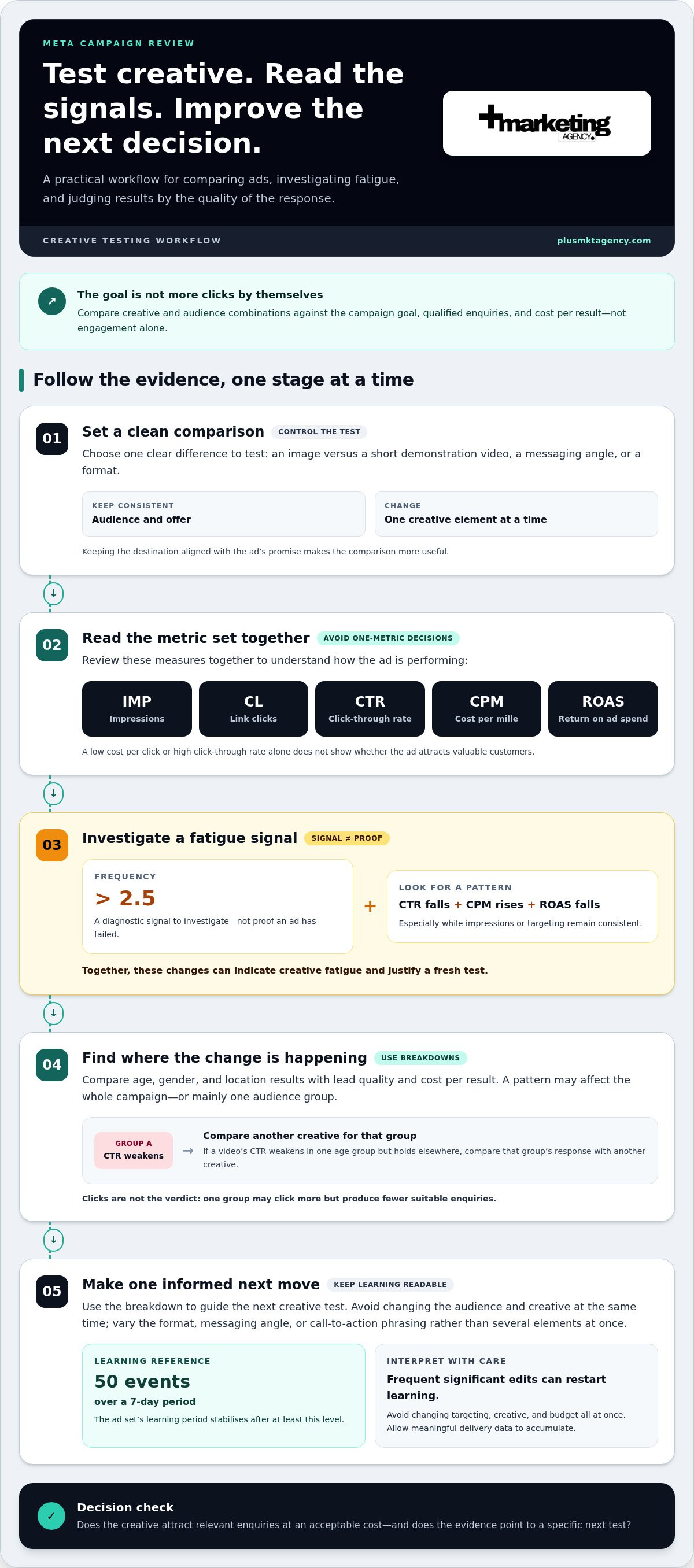
Learning also affects the timing of optimisation decisions. A Meta ad set’s learning period stabilises after a minimum of 50 events over a 7-day period. Frequent significant edits can trigger a new learning period, so avoid changing targeting, creative, and budget all at once. Change one major input, then judge performance against the campaign’s chosen result.
Audience overlap can split data collection across similar ad sets, making it harder for each to learn effectively. Consolidate groups when they share the same offer and objective. Keep campaigns separate when they serve distinct funnel stages, use substantially different creative or offers, or cover diverse product categories. Consider further segmentation when conversions are coming in within budget.
Match budget pacing to the campaign’s delivery period and the evidence available. Track spend against the planned schedule, then compare results with your cost and lead-quality targets. Don’t scale simply because delivery is fast; first check whether the leads are relevant. Revisit the strategy when audience response weakens, and allow enough time for meaningful delivery data to accumulate.
For campaigns spanning countries, languages, and currencies, structure audiences around genuine market differences. A Malta campaign may need separate English and Maltese creative if each serves a distinct audience. Use localised offers and destinations, then compare performance in a consistent reporting currency such as EUR. Keep the market’s transaction currency visible in revenue records to make comparisons clear.
Using creative and demographic breakdowns
Compare creative and audience breakdowns to see which combinations attract attention and qualified responses. Judge each result against the campaign goal, not engagement alone.
Creative Testing and Fatigue Monitoring
Creative testing compares images, videos, messages, or formats to find which versions produce stronger campaign results. It matters because an ad that once attracted clicks can lose relevance as people see it repeatedly. Test one clear difference at a time, such as a product image versus a short demonstration video. Keep the offer and audience consistent so the comparison is useful.
Review impressions, link clicks, click-through rate (CTR), cost per mille (CPM), and return on ad spend (ROAS) together. Frequency above 2.5 is a diagnostic signal to investigate, not proof by itself that an ad has failed. Look for declining CTR, rising CPM, and declining ROAS while impressions or targeting remain consistent. That pattern can indicate creative fatigue and justify a fresh test.
Use breakdowns to see whether a pattern appears across the campaign or mainly within a particular audience group. For example, if a video’s CTR weakens among one age group but holds steady elsewhere, compare that group’s response with another creative. Avoid changing the audience and creative at the same time, as this makes it harder to identify the cause of a performance shift.
Ad Creative Best Practices
Creative testing best practices make performance comparisons clearer through repeatable choices. Vary the format, messaging angle, or call-to-action phrasing rather than changing several elements at once. For a local service, compare a clear explanation of the service with a customer-problem angle, then assess which attracts relevant enquiries. Keep the destination and offer aligned with the ad’s promise.
Demographic breakdowns help explain who responds, but they don’t show why someone converted. Compare age, gender, and location results with lead quality and cost per result. If one group generates more clicks but fewer suitable enquiries, it may not be the stronger audience. Use the comparison to guide your next creative test, rather than assuming everyone in that group shares the same need.
Keep the core message recognisable across image and video versions. Make the main benefit, offer, and next action clear, then test a distinct visual or wording choice. Review creative results across placements and demographic groups before reallocating spend. A strong CTR but weak lead quality calls for a message or offer review. A declining CTR alongside rising CPM and lower ROAS supports testing refreshed creative.
Record each test’s creative, audience breakdown, and result in a simple comparison log. This makes patterns easier to spot across successive tests and helps prevent one unusual result from driving a campaign change.
Campaign attribution and revenue analytics
Attribution connects campaign activity with actions people take after seeing or clicking an ad. Revenue analytics show whether those actions contribute commercial value.
Track results against the campaign objective, then compare cost per result with lead quality and revenue. Click-through and cost-per-click metrics can help assess how people respond to an ad and what it costs to attract clicks.
Campaign Attribution
Campaign attribution assigns conversions to advertising interactions using a chosen measurement approach. It matters because a lead or sale may happen after an ad click, while a click alone doesn’t prove business impact. Review Meta results alongside customer and sales records to understand which campaigns contribute to enquiries, bookings, or purchases.
Start by defining the conversion that matters, such as a submitted lead form or completed purchase. Then check that the event is recorded consistently. Meta results count outcomes based on the selected objective and settings, while app installs are recorded as app events and attributed to ads. These definitions shape what campaign reporting can show.
Use Meta Events Manager to review event activity and identify gaps between ad interactions and recorded conversions. For server-side events, validate Conversions API parameters and check for missing values or malformed fields. Sending email, phone, and click identifiers server-side can improve event match quality. Better matching helps connect recorded actions with campaign activity, but it doesn’t replace sales validation.
For a lead campaign, compare submitted leads with the records sales staff mark as qualified. For a purchase campaign, match reported conversions with completed transactions. Keep the conversion definition consistent across campaigns so changes in attribution aren’t mistaken for actual performance changes.
Revenue Analytics and Performance Metrics
Revenue analytics assess campaign outcomes in financial terms, rather than treating every conversion as equally valuable. They help distinguish a low-cost lead that never progresses from one that becomes a customer. Compare cost per result with revenue and lead quality to decide whether a campaign supports your business goal.
Use a focused set of measures:
- Impressions: how many times ads appeared on screen.
- Link clicks: clicks leading to advertiser-specified destinations on or off Meta technologies.
- CTR, CPC, and CPM: engagement and delivery-cost measures, with CPM representing the average cost for 1,000 impressions.
- Results and cost per result: outcomes and their average cost, which vary with the selected goal, such as in-app purchases or trial starts.
- Revenue and ROAS: recorded sales value and the return associated with advertising spend.
Read these metrics as a sequence. If impressions remain steady but link clicks fall, investigate the ad’s relevance or message. If clicks continue but qualified leads decline, review the form, offer, and conversion tracking. If reported revenue differs from completed sales, reconcile transaction records and event reporting before reallocating spend.
For example, a service business can compare campaign-generated enquiries with booked work and the revenue recorded from those bookings. This puts cost per lead in context and supports decisions based on customer value, not click volume alone.
Campaign diagnostics and performance alerts
Review performance regularly to catch delivery changes before they distort campaign decisions. Meta lets you monitor performance at campaign, ad set, and ad levels through Charts or History.
Common optimisation mistakes include changing several settings at once, reacting to short-term fluctuations, and judging success by cheap clicks alone. Significant ad set changes can trigger a new learning period, affecting how you interpret results.
Set a daily review rhythm of 10-15 minutes. Check spend pacing against the plan, KPI thresholds, automation triggers, and top-creative CTR. For example, rising spend with falling link-click rates may signal a delivery or creative issue. Compare the movement with your campaign objective before making a change.
- Spend pacing: note whether delivery is ahead of or behind the planned budget schedule.
- KPI thresholds: flag results that cross the limits set for your campaign.
- Automation triggers: confirm automated rules are responding as intended.
- Top-creative CTR: watch for a drop that could warrant creative review.
Reserve 1-2 hours weekly for a deeper review. Assess funnel-stage performance, test validity, and CPA and ROAS by cohort. Then decide what to pause, scale, or refresh. A campaign can attract clicks yet underperform at the lead stage, so trace the path from exposure to business outcome.
Use Meta’s Charts or History to identify where a change occurred. Campaign-level trends show the overall direction, ad set data helps isolate audience or delivery shifts, and ad-level results reveal creative differences. Comparing these levels helps prevent a weak ad from being mistaken for a campaign-wide problem.
Record significant edits and when they happened. If results change after several adjustments, it becomes harder to isolate the cause. Change one major input, such as budget or targeting, then compare subsequent delivery with the original KPI thresholds. Avoid repeatedly resetting the learning period with unnecessary edits.
Performance alerts are most useful when tied to a decision. A spend-pacing alert calls for a delivery check; a KPI alert calls for investigating the relevant metric. If a strong CTR brings poor-quality leads, review the form or offer before increasing spend. If one cohort weakens while others hold steady, assess that segment rather than pausing every ad.
For example, a weekly review may show stable impressions but weaker CPA in one cohort. Check funnel-stage performance and test validity before reallocating budget. If the shift follows a major ad set change, account for the new learning period. This diagnostic process helps distinguish a genuine performance issue from a temporary reporting fluctuation.
Lookalike audience quality and overlap
Lookalike audiences help Meta find people who resemble a selected source audience. Their value depends on who is in that source, not simply its size. A list of repeat customers gives Meta a different signal from a list of every enquiry. Start with the business outcome you want to grow, then choose source data that reflects it.
Standard Meta lookalike audiences range from 1% to 5%. The percentage describes audience breadth, not lead quality. A narrower selection may stay closer to the source characteristics, while a broader selection can reach more people. Compare options using qualified leads, cost per result, and later sales outcomes. Don’t choose a percentage based on reach alone.
Source quality matters most. For example, a list of customers who completed purchases may be more relevant to revenue growth than one containing unqualified enquiries. If repeat purchases matter, use customer records that distinguish returning buyers. If the goal is bookings, use completed bookings rather than form submissions alone. Consistent source definitions make comparisons more meaningful.
Improve the signals Meta receives by implementing the Conversions API for server-side events. Regularly upload lifetime-value lists to support higher-quality lookalike audiences. Include accurate event and customer information, then validate event parameters in Meta Events Manager. Missing values or malformed fields can weaken matching. Email, phone, and click identifiers sent server-side can also improve event match quality.
- Choose a relevant source: use completed customers or valuable leads that match the campaign goal.
- Check the signal: confirm events and customer values are accurate in Meta Events Manager.
- Compare audience ranges: assess 1% to 5% options using qualified outcomes, not reach alone.
- Review overlap: identify whether similar ad sets compete for the same people.
Overlap can split data collection across similar ad sets and make learning less effective. If two ad sets use the same source, location, and offer, compare their audiences before keeping both. Consolidation can concentrate event data when campaigns share an objective. Keep them separate when they serve distinct funnel stages, use substantially different offers, or cover diverse product categories.
Evaluate audience quality beyond the first conversion. Compare lead relevance, booked appointments, completed sales, and customer value across lookalike groups. For example, a broader audience may produce more form submissions but fewer attended appointments. That difference points to a source or qualification issue, not necessarily a need for greater reach. Track outcomes by audience and campaign objective.
For support using audience signals in Meta campaigns, explore Meta advertising support and align targeting with your lead-quality goals.
Plus Marketing Agency: Meta Advertising
Plus Marketing Agency helps businesses improve Meta campaigns through audience strategy, creative testing, and performance reporting. Its Meta Advertising and Lead Generation services support businesses seeking more qualified enquiries, while Conversion Tracking connects campaign activity with measurable actions.
Turn to this support when campaign results are difficult to interpret, lead quality needs attention, or tracking doesn’t show which activity contributes to enquiries and sales. A structured process moves from discovery and strategy to launch, optimisation, and reporting, tying decisions to campaign data and business goals.
If you’re ready to review your campaign approach, contact Plus Marketing Agency to discuss your Meta advertising needs.
Make the next campaign decision count
Treat the next campaign cycle as a commercial decision, not a reset. Before changing direction, agree on what the business needs next: more qualified enquiries, stronger booking intent, or clearer evidence of sales contribution. That priority gives your team a practical basis for choosing what to do next. To optimise Meta ad campaigns effectively, connect each adjustment to a business objective, then assess its value against that objective.
Set a clear decision point for the next review. Identify who will assess the results and which business outcome will shape the follow-up. This keeps campaign activity connected to operational priorities, rather than leaving performance data without a clear next action.
Plus Marketing Agency offers Meta Advertising, Google Search Visibility, and Lead Generation to support businesses focused on customer acquisition and measurable growth.
Contact Plus Marketing Agency for support with your next campaign decision.
A clear priority is a practical starting point for stronger growth.
Frequently Asked Questions
What are the best practices for optimising Meta ad campaigns?
Strong practices connect the ad promise, enquiry form, and sales follow-up. To optimise Meta ad campaigns, define what makes a lead useful before launch, such as a suitable service area, booking date, or project type. Keep form questions focused on those qualifying details. Then share sales feedback with the campaign team so future messaging attracts prospects who fit the offer, rather than simply increasing submissions.
What Meta Ads budget and bidding strategies work best?
The best approach sets spending around affordable testing and scales only after lead quality holds up. Match the bid approach to the campaign’s commercial priority, such as controlling acquisition costs or pursuing more conversions, and judge it against accepted leads rather than volume alone. For proven Tier 1 campaigns, the research recommends increasing budgets by 20-30% weekly. Review lead outcomes after each increase before making another adjustment.
How do you run A/B tests for Meta ads?
Run a controlled comparison by recording one hypothesis and changing one element, such as the headline or landing-page offer. Keep the audience, placement, and conversion goal consistent so the result is easy to interpret. Choose the primary success measure before launch, then allow results to accumulate. For example, when testing a headline, compare qualified enquiries rather than naming a winner based on early clicks alone.
How often should you refresh Meta ad creative and audiences?
Refresh creative or audiences in response to performance signals, not an arbitrary calendar date. If response weakens while delivery conditions remain similar, prepare a new message or format. If lead relevance drops, reassess whether the audience source still reflects current customers and offers. Sales feedback can reveal shifts that platform metrics miss, such as more enquiries coming from people who aren’t a good fit for the service.


